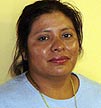
Julia Gabriel: "Como trabajadores y mujeres, tenemos que luchar por nuestros derechos y contra la violencia tanto en la labor como en la casa" "As women and as workers, we have to fight for our rights and against violence both in the fields and in our own homes"
You and your friends -- your fellow students, neighbors, co-workers, or members of your church -- are the very heart of this campaign!
If you have come to this site because you want to help make FAIR FOOD a reality, you can use the tools below to bring the Taco Bell boycott to your community.
But, first... Please consider donating to the CIW!We need your support to keep the boycott, the anti-slavery campaign, and everything else we do going strong!
Click on the Pay Pal link below to send a secure donation now!
Now, here are some great tools for organizing at home:
E-mail Petition send an email to Emil (Emil Brolick, TB's CEO)
Or, send an automated fax to Emil Brolick, Taco Bell CEO, from this link on the United Church of Christ web site - It's easy and a great way to support the boycott without even getting up from your seat!
Thanks for joining us, and don't forget to send us any news, photos, or media reports on actions in your community -- we'll post them as soon as we can and your action can help motivate thousands of visitors to the site across the country!
Coalition of Immokalee Workers
WHO WE ARE
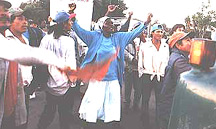
1995 General Strike Immokalee, Florida
The CIW is today spear-heading the Taco Bell boycott. But before we launched the national boycott in April of 2001, we had been organizing locally for many years in an effort to modernize labor relations in Florida's fields, improve wages and working conditions for our members, and eliminate modern-day slavery.
To learn more about the history of the Coalition, you can go to the CIW site where you'll find all the non-Taco Bell info on the Coalition from 1995 to 2001, including past CIW campaigns, Press Archives, Photo Galleries, and more!
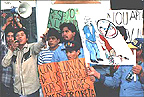
1997 General Strike Immokalee, Florida
Or, you can simply click on some of the links here below to go directly to the pages from the CIW site that interest you... just remember to hit the back button on your browser to return to the boycott site!:
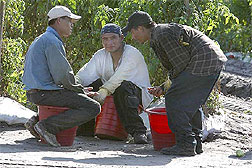
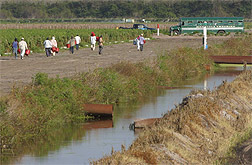
Waiting for the fields to dry in the morning... After getting work sometimes as early as 5:00 am, workers often don't actually start picking until 10:00am, until the dew has dried on the tomato plants. This waiting time, of course, is all-too-often not paid and has been the subject of innumerable legal complaints.
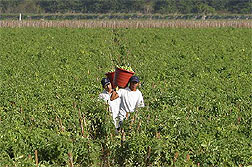
The long walk to the truck... The full buckets weigh roughly 32 pounds -- at 40 cents per bucket, that means you have to pick and haul 2 tons of tomatoes to make $50 in a day's work.
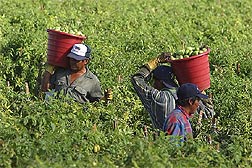
Working by the piece, there is no time to stop or talk with co-workers. Every minute counts in the back-breaking tedium of piece work harvesting.
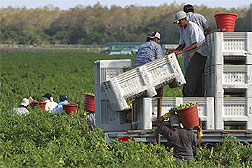
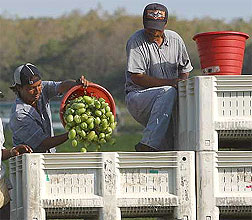
Readying to throw the 32-lb bucket up to the dumpers..
Tomatoes picked, hauled, and now on their way to the packing house. Next stop -- a fast-food restaurant near you...
Heading home after a long day.
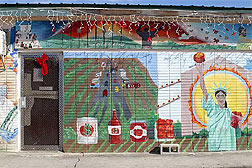
Back in town, the CIW headquarters sits next to the Immokalee's central parking lot where workers find work and are dropped off every day.
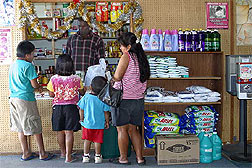
The CIW cooperative offers staple foods and necessities at nearly half the price of the local stores.
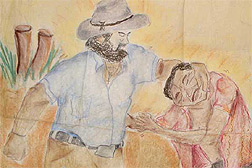
CIW art, collected from several years of struggle and reflecting the evolving focus of our organizing efforts over the years, is found throughout the CIW's community center. This drawing, depicting a beating of a worker at the hands of his crewleader, was a key image in the early years of CIW organizing, and in the birth of what is today the CIW's anti-slavery campaign.
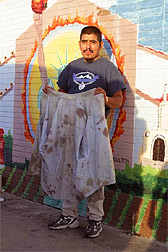
Lucas Benitez, a CIW organizer and farmworker, stands outside the office with a bloody shirt worn by a CIW member who was beaten by a field supervisor in 1996 for the infraction of wanting to drink water in the afternoon of a particularly hot day in the tomato fields. That beating launched our first "Campaign to End Violence in the Fields," including a nighttime march of 500 workers to the house of the crewleader involved in the incident. Since that march, there have been no further reports of beatings in Immokalee, where there were a common occurence in the years before workers started to unite.